
What FIU registration means
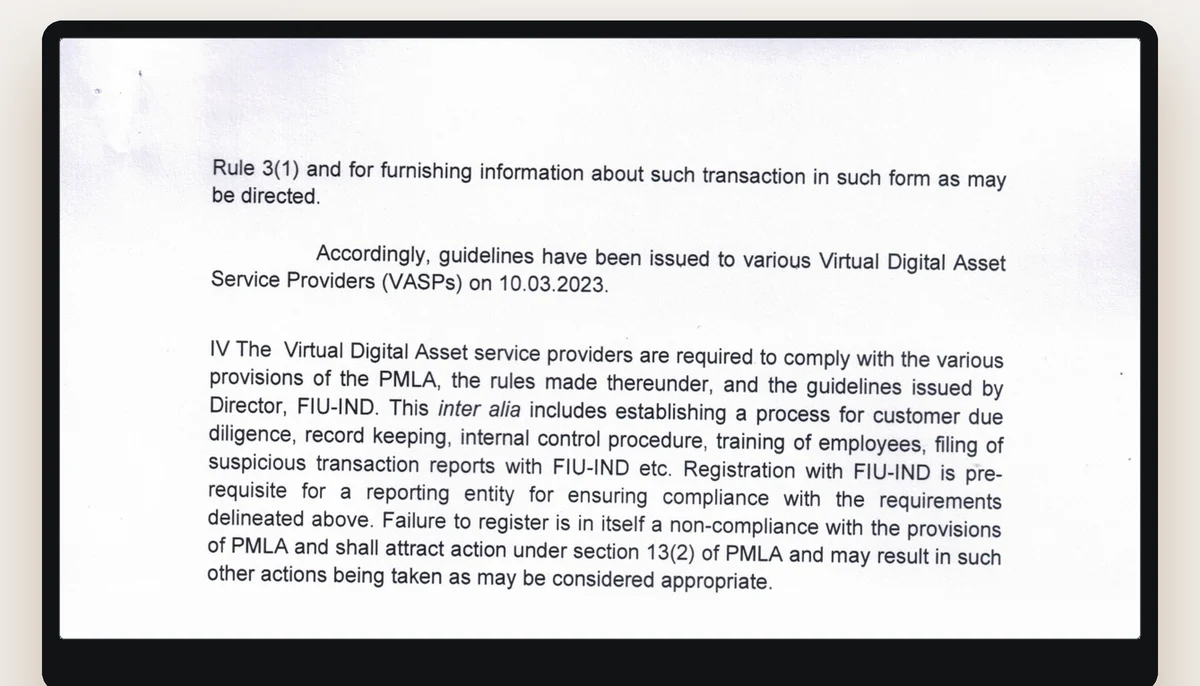
Registration with the Financial Intelligence Unit - India places duties on a provider under the anti-money-laundering law. It is not a licence from SEBI or the RBI, not a guarantee of custody, and not investor protection. This page explains what registration obliges a provider to do, and what it leaves unsaid.
The obligations registration places on a provider
A provider registered with the FIU as a virtual digital asset service provider must identify its customers, keep records of their transactions, and report certain transactions to the FIU. These duties come from the anti-money-laundering law and the rules made under it. The provider must verify who its customers are, using documents that prove identity and address, and it must keep those records for a period set by law. It must also watch for transactions that look suspicious and report them to the FIU.
These obligations are about the flow of money and the identity of the people moving it. They are not about the safety of the provider’s systems or the soundness of its business. A provider can meet all its anti-money-laundering duties and still lose a client’s coins through a hack, or fail to return a withdrawal. The register records that the provider has taken on these duties, not that it has been checked for anything else.
What registration is not
Registration with the FIU is not approval by SEBI, the RBI, or any other regulator. SEBI regulates securities markets and licenses stockbrokers and investment advisers; the RBI regulates banks and payment systems. Neither body licenses crypto exchanges or wallets. The FIU is not a market regulator; it is the agency that receives reports about suspicious transactions. Its register is a list of entities that have registered as reporting entities, not a list of entities that have been approved to do business.
A reader should not read “registered” as “safe”. The word “registered” means the provider has filed the required papers and accepted the reporting duties. It does not mean the provider has been inspected, audited, or found to be honest. The FIU does not publish findings about the quality of a provider’s custody or the fairness of its fees. Those are matters for the reader to check elsewhere.
Why “registered” and “safe” are different words
The word “registered” describes a legal status: the provider is on a list kept by the FIU. The word “safe” describes a judgment about risk: the chance that the provider will lose a reader’s money or coins, or fail to return them. The two words are not the same, and one does not imply the other. A provider can be registered and unsafe, and a provider can be unregistered and still return every coin.
This site does not use the word “safe” to describe any provider, and it does not advise a reader to treat registration as safety. The FIU register is a fact about the provider’s reporting duties, not a finding about its business. A reader who wants to judge safety must look at the provider’s custody arrangements, its withdrawal terms, its history, and the law that applies to it. None of those are on the FIU register.
What registration leaves unsaid
The FIU register says nothing about custody. It does not say where a provider keeps its clients’ coins, whether it keeps them in cold storage or hot wallets, or whether it segregates client assets from its own. It says nothing about investor protection: there is no compensation fund for crypto losses, and no ombudsman to hear complaints. It says nothing about the provider’s solvency, its insurance, or its ability to meet withdrawals.
A reader should not assume that a registered provider holds coins safely. The register is silent on that question. If a provider fails, the reader may have no recourse beyond the courts. The pages on this site explain what a reader should look for in an exchange’s terms about segregation and withdrawals, and they set out the tax and banking questions. But the register itself answers only one question: is this provider on the list? It does not answer the question a reader most wants answered: is this provider safe?
The difference between FIU registration and a licence
A licence is a permission to do something, granted by a regulator after a check. SEBI licenses stockbrokers after examining their capital, their systems, and their people. The RBI licenses banks after a similar process. The FIU does not license virtual digital asset service providers; it registers them. Registration is a filing, not an examination. The provider files information about its business and its officers, and the FIU adds it to a list. The FIU does not inspect the provider’s systems or verify its claims.
This difference matters. A reader who sees “FIU registered” may think the provider has been vetted, but it has not. The FIU’s own website states that registration does not mean the FIU has approved the provider’s business. This site repeats that warning: registration is a duty, not a permission. It is a fact, not a verdict.
What a reader should do with this knowledge
A reader who is considering a provider should first check whether the provider is on the FIU register. If it is, the reader knows the provider has accepted reporting duties. But the reader should then look at the provider’s own documents: its terms of service, its custody statement, its withdrawal policy. The reader should ask where the coins are held, who controls the keys, and what happens if the provider fails. The reader should also think about tax and banking, which are explained on other pages.
This site does not tell a reader which provider to use. It explains what registration means and what it does not mean, and it leaves the decision to the reader. The FIU register is one fact among many. A reader who treats it as the only fact is making a mistake that this site is built to correct.
A registered provider must still be checked for its own custody and insolvency record
Registration with the Financial Intelligence Unit tells you one thing: the provider has filed paperwork under the anti-money-laundering law. It does not tell you whether the provider keeps your coins in a separate wallet or whether it can meet a sudden wave of withdrawal requests. Those are questions of custody and balance-sheet strength, and they are not part of the FIU filing.
An exchange can be on the register and still hold customer assets in a single pool that it uses for its own trading. If the exchange fails, the liquidator may treat your coins as part of the exchange’s general assets. You would become an unsecured creditor, waiting in the same queue as vendors and lenders, with no special claim.
Before you place any meaningful amount with a provider, read its terms for the words that describe segregation of customer assets. Look for a clear statement that your holdings are kept apart from the provider’s own funds and are not available to its creditors. If the terms are silent or hedged, treat the absence of that promise as a risk you are carrying.
The tax deduction on a trade is a withholding, not a final tax
When you sell or transfer a virtual digital asset, the platform or the buyer may deduct tax at source before paying you. That deduction is not the tax itself; it is an advance against what you owe. The actual tax is calculated later when you file your return, and the deduction is adjusted against that final amount.
The amount deducted depends on the value of the transaction and the rules in force at the time. A small trade may have no deduction, while a larger one may have a deduction at the prescribed rate. The deduction happens even if you are selling at a loss, because the withholding is on the transaction value, not on the gain.
Because the deduction is automatic, you may find that the cash you receive is less than the sale price. You can claim the deducted amount as a credit when you file, but only if you report the transaction and keep the records. If you do not file, the credit is lost and the deduction becomes an extra cost.
A bank freeze after a peer-to-peer trade is usually not a criminal charge
When a bank freezes your account after a peer-to-peer crypto purchase, it is often acting on a complaint from another account holder who says they were defrauded. The bank may place a lien on the funds that came in from the counterparty, not on your entire balance. That freeze does not mean the police have charged you with anything.
The freeze can last while the bank and the investigating agency work out which funds are linked to the complaint. You may be asked to provide the chat records, the payment proof and the exchange’s transaction ID. If you can show that you received the money in exchange for crypto you actually sent, the freeze may be lifted for the unaffected portion.
What you should not do is ignore the freeze and open a new account to continue trading. That can look like evasion and may make it harder to get the freeze removed. Instead, keep a file for each peer-to-peer trade with the counterparty’s name, the amount, the time and the exchange’s reference. That file is what you will show the bank.
Self-custody removes one set of risks and adds another
When you hold your coins in a wallet whose private keys only you control, no exchange can freeze your balance or block your withdrawal. You are not exposed to the risk that the exchange will be hacked, go bankrupt or simply refuse to process a request. The coins are yours in a way that no claim on an exchange can match.
But self-custody means you are the only person who can recover the wallet if you lose the seed phrase or the device. There is no password-reset email and no customer support desk. If the seed phrase is lost, the coins are gone, and no regulator can order anyone to restore them because there is no third party holding them.
The choice between self-custody and an exchange is not a choice between safe and unsafe. It is a choice between two different sets of failures. An exchange can fail as a business or as a custodian; a self-custody wallet can fail through your own mistake. Most readers will use both, keeping small amounts on an exchange for trading and larger amounts in a wallet they control.
The complaint process after a provider fails
A registered provider must follow anti-money-laundering rules, but that does not create a simple complaints desk for customer losses. If a platform collapses or freezes withdrawals, the FIU will not step in to recover your coins or refund your rupees. Its interest is in whether the provider reported suspicious transactions and kept records, not in whether your balance is honoured.
You may still complain to the police about a fraud, or to a consumer forum about a deficiency in service, but these routes are slow and uncertain. The fact of FIU registration does not guarantee that the provider will respond to a legal notice or appear before a forum. If the entity is registered offshore, enforcing any order in India becomes harder still.
Before depositing money or coins, check what address the provider lists for complaints and whether it names any Indian entity. A provider that gives only a chatbot or an email address on a foreign domain leaves you with fewer practical options. Registration with the FIU is about reporting, not about answering to you when things go wrong.
At a glance
Read next
Crypto questions Indian readers ask
Is FIU registration the same as a licence?
No. Registration is a filing under the anti-money-laundering law, not a licence. A licence is a permission granted after a check; registration is a duty accepted by the provider. The FIU does not inspect or approve providers; it simply lists them.
Does registration protect my coins?
No. The register says nothing about custody. A registered provider can still lose your coins through a hack or fail to return them. There is no compensation fund for crypto losses in India.
Can I complain to the FIU if a provider loses my money?
The FIU does not handle consumer complaints. It receives reports about suspicious transactions. If a provider loses your money, you may need to go to court or use any dispute mechanism the provider offers.
Does registration mean the provider is honest?
No. The FIU does not assess the honesty or competence of providers. Registration means the provider has filed the required papers and accepted reporting duties. It is not a character reference.
Should I only use registered providers?
This site does not give advice. Registration is one fact to consider, but it is not a guarantee of safety. You should weigh it with other factors, including the provider’s custody arrangements and your own risk tolerance.
Open an account with FxPro
FxPro is an international broker offering contracts for difference on crypto and other markets. The account is leveraged and risky; this site is not the broker and takes no money from you.