
The providers on the FIU register
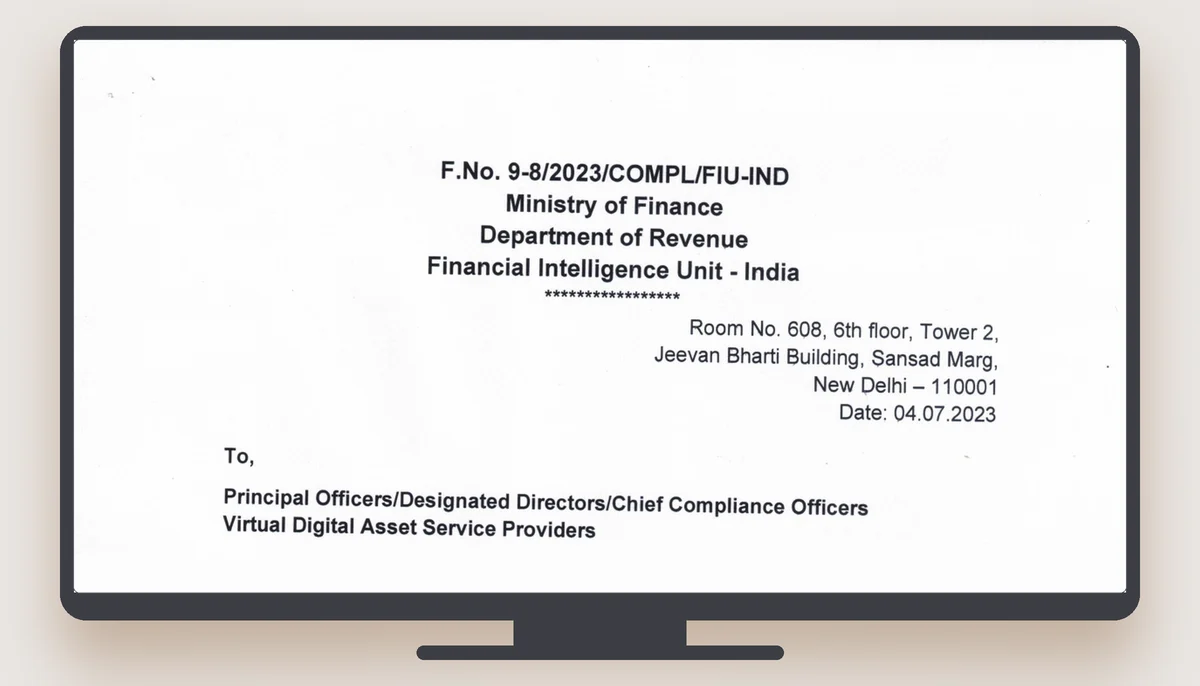
The table above lists the providers the Financial Intelligence Unit - India has registered as reporting entities for virtual digital asset service provision. Each row records what the source published: the name exactly as the source wrote it, the date the source gave, the kind of service listed, and a link to the original. A row is a record of the source, not a finding by this site.
Registered virtual digital asset providers
The provider's name as the FIU lists it and the date given.
| Provider as listed | List as on | Status in the list | Source |
|---|---|---|---|
| Registered reporting entities | |||
| Onmeta → ABHIBHA Technologies Private Limited | 09.03.2026 | Registered with FIU-IND | Lok Sabha ↗ |
| Alpyne → ALSD Technologies Private Limited | 09.03.2026 | Registered with FIU-IND | Lok Sabha ↗ |
| Suncrypto → Angelic Infotech Private Limited | 09.03.2026 | Registered with FIU-IND | Lok Sabha ↗ |
| ANQ Finance → ANQ Digital Finserv Private Limited | 09.03.2026 | Registered with FIU-IND | Lok Sabha ↗ |
| ARDOUR Labs Private Limited | 09.03.2026 | Registered with FIU-IND | Lok Sabha ↗ |
| ArthBit → Arthbit Private Limited | 09.03.2026 | Registered with FIU-IND | Lok Sabha ↗ |
| Zebpay → Awlencan Innovations India Limited | 09.03.2026 | Registered with FIU-IND | Lok Sabha ↗ |
| Bitbns → Bitbns Internet Private Limited | 09.03.2026 | Registered with FIU-IND | Lok Sabha ↗ |
| Coinswitch → Bitcipher Labs LLP | 09.03.2026 | Registered with FIU-IND | Lok Sabha ↗ |
| Blockoville → Blockoville OU | 09.03.2026 | Registered with FIU-IND | Lok Sabha ↗ |
| Onramp → Buyhatke internet private limited | 09.03.2026 | Registered with FIU-IND | Lok Sabha ↗ |
| Bybit → Bybit Fintech Limited | 09.03.2026 | Registered with FIU-IND | Lok Sabha ↗ |
| Carret → Carretx Technologies Pvt. Ltd. | 09.03.2026 | Registered with FIU-IND | Lok Sabha ↗ |
| Coinbase → Coinbase India Private Limited | 09.03.2026 | Registered with FIU-IND | Lok Sabha ↗ |
| Rario → Digital Collectibles Pte. Ltd. | 09.03.2026 | Registered with FIU-IND | Lok Sabha ↗ |
| Eclipton → Eclipton Technologies Private Limited | 09.03.2026 | Registered with FIU-IND | Lok Sabha ↗ |
| Delta Exchange → Excelium Technologies Private Limited | 09.03.2026 | Registered with FIU-IND | Lok Sabha ↗ |
| FanCraze Technologies Inc. | 09.03.2026 | Registered with FIU-IND | Lok Sabha ↗ |
| Stable Pay → Fincrypt LLP | 09.03.2026 | Registered with FIU-IND | Lok Sabha ↗ |
| Liminal → First Answer India Technologies Pvt Ltd | 09.03.2026 | Registered with FIU-IND | Lok Sabha ↗ |
| Flitpay → Flitpay Private Limited | 09.03.2026 | Registered with FIU-IND | Lok Sabha ↗ |
| Giottus → Giottus Technologies Pvt Ltd | 09.03.2026 | Registered with FIU-IND | Lok Sabha ↗ |
| Buyucoin → IBLOCK Technologies Private Limited | 09.03.2026 | Registered with FIU-IND | Lok Sabha ↗ |
| Inocyx → Inocyx Technologies Private Limited | 09.03.2026 | Registered with FIU-IND | Lok Sabha ↗ |
| KoinBX → Kooz Advisors and Technologies Private Limited | 09.03.2026 | Registered with FIU-IND | Lok Sabha ↗ |
| pi42 → Lightningnodes Technologies Private Limited | 09.03.2026 | Registered with FIU-IND | Lok Sabha ↗ |
| Bitbse.com → Longreen India Private Limited | 09.03.2026 | Registered with FIU-IND | Lok Sabha ↗ |
| Fanztar → Metatoken Technologies Private Limited | 09.03.2026 | Registered with FIU-IND | Lok Sabha ↗ |
| Mindless Pandora Tech Solutions Private Limited | 09.03.2026 | Registered with FIU-IND | Lok Sabha ↗ |
| Coin DCX → Neblio Technologies Private Limited | 09.03.2026 | Registered with FIU-IND | Lok Sabha ↗ |
| Binance → Nest Services Limited (Earlier Binance International Limited) | 09.03.2026 | Registered with FIU-IND | Lok Sabha ↗ |
| CoinswitchX → Nextgendev Solutions Private Limited | 09.03.2026 | Registered with FIU-IND | Lok Sabha ↗ |
| KuCoin → Peken Global Limited | 09.03.2026 | Registered with FIU-IND | Lok Sabha ↗ |
| Rario → Rario Digital Private Limited | 09.03.2026 | Registered with FIU-IND | Lok Sabha ↗ |
| Getbit → REMIZO Technologies India Private Limited | 09.03.2026 | Registered with FIU-IND | Lok Sabha ↗ |
| Mudrex → RPFAS Technologies Private Limited | 09.03.2026 | Registered with FIU-IND | Lok Sabha ↗ |
| BIT24HR → SUBHX INFOTECH (OPC) PRIVATE LIMITED | 09.03.2026 | Registered with FIU-IND | Lok Sabha ↗ |
| eXchange1.India → UAB WEB 3 UTILITY IT SERVICES INDIA PRIVATE LIMITED | 09.03.2026 | Registered with FIU-IND | Lok Sabha ↗ |
| eXchange1 → UAB “Web 3 Utility Platform” | 09.03.2026 | Registered with FIU-IND | Lok Sabha ↗ |
| Pyor → UCY Technology Private Limited | 09.03.2026 | Registered with FIU-IND | Lok Sabha ↗ |
| Unocoin → Unocoin Technologies PVT LTD | 09.03.2026 | Registered with FIU-IND | Lok Sabha ↗ |
| WazirX → Zanmai Labs PVT LTD | 09.03.2026 | Registered with FIU-IND | Lok Sabha ↗ |
| Conditionally on-boarded | |||
| BitDelta → Durva Fintech Private Limited | 09.03.2026 | Conditionally on-boarded | Lok Sabha ↗ |
| PLATINX → Eopsin Tech Private Limited | 09.03.2026 | Conditionally on-boarded | Lok Sabha ↗ |
| Parracrypto → PARAACRYPTO TECHNOLOGY PRIVATE LIMITED | 09.03.2026 | Conditionally on-boarded | Lok Sabha ↗ |
| Not operational or wound up | |||
| Ante Multimedia Private Limited | 09.03.2026 | Not operational or wound up | Lok Sabha ↗ |
| Square → Damsol Pvt Ltd | 09.03.2026 | Not operational or wound up | Lok Sabha ↗ |
| Bytex → FIN GENIE Tech Private Limited | 09.03.2026 | Not operational or wound up | Lok Sabha ↗ |
| Density Exchange → Pagarpay India Private Limited | 09.03.2026 | Not operational or wound up | Lok Sabha ↗ |
| Rovi91 Innovations Private Limited | 09.03.2026 | Not operational or wound up | Lok Sabha ↗ |
| Cryptosmartlife → Smartliving Digital Technologies Pvt. Ltd | 09.03.2026 | Not operational or wound up | Lok Sabha ↗ |
| Transak → Transak Technology India Private Limited | 09.03.2026 | Not operational or wound up | Lok Sabha ↗ |
| Valr → Veeratva Technologies Private Limited | 09.03.2026 | Not operational or wound up | Lok Sabha ↗ |
| Coindhan → WOLLFISH Labs Pvt Ltd | 09.03.2026 | Not operational or wound up | Lok Sabha ↗ |
What the columns show
The table above shows four things for each provider: the name as the FIU wrote it, the date the FIU published, the kind of service the provider is listed for, and a link to the original entry on the FIU’s own page. The name is not corrected for spelling or brand; if the source writes a name in a particular way, the table repeats it. The date is the one the source gives; where the source gives no date, the table says so rather than guessing. The kind of service is taken from the source’s own classification, and this site does not add categories or interpret them.
The link goes to the original entry on the FIU’s website, so a reader can check the table against the source. The link is not a link to the provider’s own site, and this site does not endorse any provider by listing it. The table is a copy of a public register, not a recommendation.
A reader comparing the table to the source should remember that the source may change after this site reads it. The FIU can add, remove or amend entries at any time, and this site reads the list once a week. The table above is the state of the source on the day it was read, not a live feed. If a reader finds a difference between the table and the source, the source is the one to trust. This site does not archive past versions of the list, so the table is the current week’s reading, not a historical record.
The date on a row
Each row carries the date the FIU gave for that provider’s registration or listing. The date is not the date this site read the list; it is the date the source published. Where the source gives no date, the table says so. The date matters because the register changes: a provider registered last year may have a different status today, and the date tells a reader when the source last recorded that provider. A reader should not assume that a date in the past means the provider is still registered today; the table is a weekly snapshot, not a live register.
The date also helps a reader check whether the provider they are looking at is the same one on the register. A provider may have changed its name or its legal entity since the date shown, and the table does not track those changes. The source may publish a new date for the same provider, and the table will show that new date when it is read. The date is one fact among several, and it should be read with the name and the kind of service.
The kind of service listed
The FIU register lists providers under categories that describe the service they are registered to provide. The table above repeats the source’s own wording for each provider, without shortening or expanding it. A provider may be listed as an exchange, a wallet service, a custodian, or some other kind of virtual digital asset service. The category is the source’s, not this site’s, and this site does not combine categories or infer that a provider offers more than the source says.
A reader should check that the service they want to use matches the category on the register. A provider listed only as a wallet service may not be registered as an exchange, and the register does not say that it is. The table above shows the category as the source wrote it; a reader who wants to know more must read the source’s own page, linked from the table. The category is a statement by the provider to the FIU, not a finding by this site.
What a row does not say
A row in the table records that the FIU has published a provider’s name, date and service category. It does not say that the provider is safe, solvent, or good at what it does. It does not say that the provider will return a reader’s coins, or that the provider’s app is free of flaws. The register is kept under the anti-money-laundering law, and its purpose is to identify entities that must report transactions and keep records. It is not a consumer-protection register, and this site does not treat it as one.
A reader should not take a row in the table as a recommendation. This site does not rate or rank providers, and it does not say which provider to use. The table is a copy of a public list, and the decision to use any provider is the reader’s own. Where a reader wants to know whether a provider is registered, the table answers that question. Where a reader wants to know whether a provider is safe, the table does not answer that question, and no page on this site does.
How to use the table with other checks
The table above is one check among several. A reader who is considering a provider should look at the name on the register, then look at the provider’s own documents to see if the legal entity matches. The provider’s terms of service, privacy policy or “about” page should name the same entity that the FIU lists. If the names do not match, the reader should ask why. The table also gives the date and the service category; a reader should check that the service they want is the one the provider registered for.
Beyond the register, a reader should look at the provider’s history, its custody arrangements, and its withdrawal terms. None of those are on the register, and this site does not collect them. The pages on this site explain what registration means and what it does not mean, and they set out the tax and banking questions a reader should think about. The table is a starting point, not a finish line.
Where the list comes from
The table above is read from the list the Financial Intelligence Unit - India publishes on its own website. The list is public, and this site reads it once a week. The source is the FIU, not any other body. The FIU is the agency that receives reports from reporting entities under the anti-money-laundering law, and its register of virtual digital asset service providers is one of several registers it keeps. This site does not add to the list or remove from it.
The link in each row goes to the source’s own page for that provider, so a reader can see the original. The source may change the list between this site’s weekly reads, and the table above is the state of the source when it was read. A reader who wants the most current list should go to the source itself. This site’s table is a convenience, not a substitute for the source.
Registration changes what the provider must report, not what you can recover
A provider on the FIU register has accepted duties under the anti-money-laundering law. Those duties run towards the government, not towards the customer. The provider must maintain records of certain transactions, verify who its customers are, and report suspicious activity to the FIU. Nothing in that arrangement creates a compensation fund or a guarantee for users who lose money.
If a registered provider collapses or refuses a withdrawal, the fact of registration does not give a customer a direct claim against the FIU or the government. The register is not a promise that the provider will remain solvent or honest. It is a record that the provider has filed the required paperwork and is expected to follow reporting rules. The distinction matters when a user assumes that a registered name is a protected one.
What a customer can do after a loss is the same whether the provider was registered or not. They can approach the police, consumer courts, or civil courts. Registration may indirectly help investigators trace funds because the provider has kept records, but it does not speed up a refund. The register gives no assurance that the provider has set aside customer assets or carries insurance against theft.
The register records a point in time, not a current status
Each row on the FIU register reflects what the provider declared at the moment of registration. The FIU publishes the names it has received, but it does not continuously certify that every provider is still operating or still compliant. A provider may stop offering services in India, change its business model, or fall out of touch with the FIU without the register being updated immediately.
For a reader, this means the table on this page is a snapshot built from the FIU's publication. The site updates the table when the FIU publishes a change, but a delay can occur. A provider's name remaining on the register should not be read as a current endorsement. It is a historical record that the provider once completed registration.
To check whether a provider is still active, a reader should look at the provider's own website, recent announcements, and any warnings from other regulators. The FIU register is a starting point, not a live monitoring service. Treat the date column in the table as the last known update from the source, not as proof that the provider is in good standing today.
A registered provider can still put your funds at risk through its own choices
Registration does not limit how a provider handles customer assets. A registered exchange may hold crypto in its own wallets, lend it out, or invest it in ways that users do not see. The FIU does not set rules for custody, capital reserves, or risk management. Those are commercial decisions made by the provider, and they can go wrong.
If a provider loses customer funds through a hack, a bad trade, or a fraud by its own staff, the FIU registration offers no safety net. The user's only recourse is against the provider itself, which may have no assets left. Many users assume that a registered provider has passed some test of financial soundness, but no such test exists under the current law.
The practical consequence is that a user should not treat the FIU register as a substitute for their own due diligence. Check how the provider stores crypto, whether it publishes proof of reserves, and what its terms say about liability. Registration tells you the provider has agreed to report to the government; it tells you nothing about the provider's internal controls or its ability to return your money.
At a glance
Read next
Crypto questions Indian readers ask
Is the FIU register a list of approved exchanges?
No. The register lists providers that have registered as reporting entities under the anti-money-laundering law. Registration is not approval by any regulator, and it is not a statement that the provider is safe or that its custody is sound. The register is a list of entities with reporting duties, not a list of recommended platforms.
Does a name on the register mean the provider is based in India?
Not necessarily. The register lists providers that serve the Indian market and have registered with the FIU, but the provider may be based elsewhere. The register does not state where a provider is incorporated or where its servers are. A reader should check the provider’s own documents for that information.
Why do some rows have no date?
The FIU’s list sometimes omits a date for a provider. Where the source gives no date, the table says so rather than guessing. The absence of a date is not a finding about the provider; it is simply a gap in the source. A reader who wants to know the date should check the source’s own page, linked from the table.
Can a provider be on the register and still be unsafe?
Yes. The register does not assess the safety of a provider’s custody, the soundness of its business, or the quality of its customer service. A provider can be registered and still lose a client’s coins, freeze withdrawals, or go out of business. Registration is one fact, not a guarantee.
What should I do if a provider I use is not on the register?
The absence of a name from the register is not proof that the provider is unlawful. It may be registered under a different legal entity, or it may have failed to register. A reader should check the provider’s legal name in its terms of service, then search the register again. If the provider is not there, the reader should weigh that fact with others, including the provider’s own statements and any local regulatory warnings.
Open an account with FxPro
FxPro is an international broker offering contracts for difference on crypto and other markets. The account is leveraged and risky; this site is not the broker and takes no money from you.