
Tax and TDS on crypto
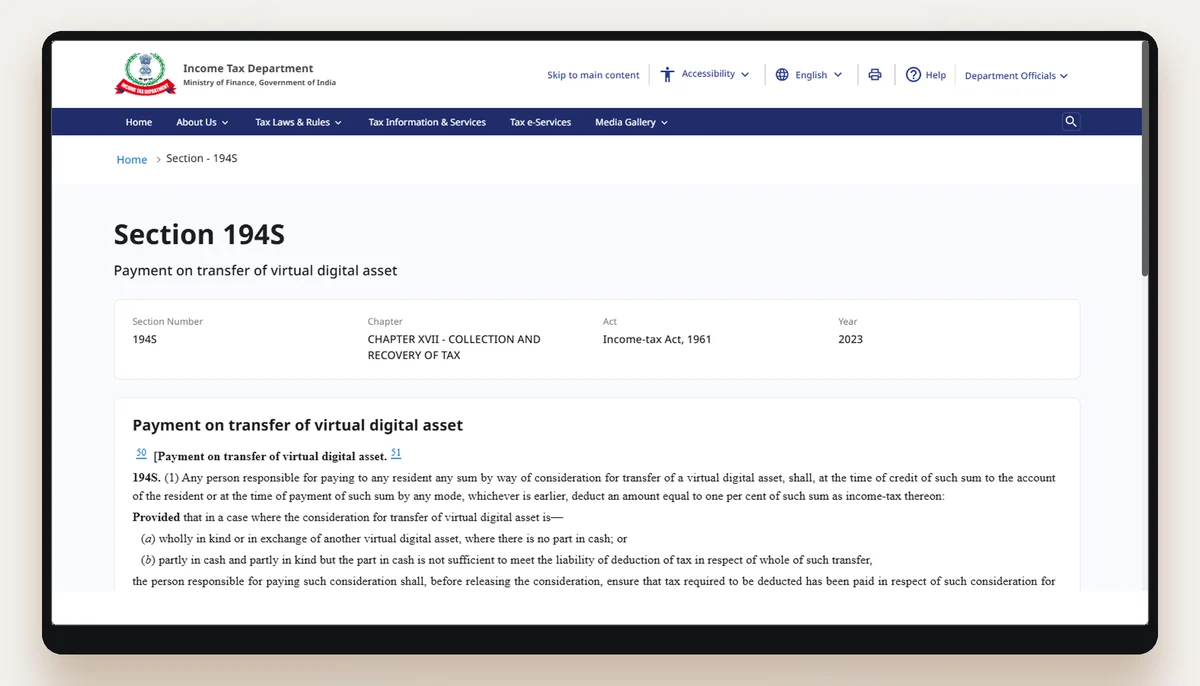
Indian tax law treats virtual digital assets as a separate class. Gains from selling them are taxed at a flat rate, losses cannot be set off against other income, and tax is collected at source on transfers. This page explains the mechanism in words; the exact rates and thresholds are in the law and may change.
The flat-rate tax on gains
When a reader sells a virtual digital asset for more than they paid for it, the profit is taxed at a flat rate set by the income tax law. The rate is the same no matter how long the reader held the asset, and it is the same for all kinds of virtual digital assets. The law does not allow the reader to reduce the gain by claiming expenses other than the cost of buying the asset, and it does not allow the reader to set off losses from virtual digital assets against gains from other income, or against gains from virtual digital assets in another transaction.
The flat rate is set out in the income tax law, and it can be changed by the government in the annual budget. This site does not quote the rate because it may be different by the time a reader reads this. A reader should check the current rate from the income tax department or a tax adviser. The mechanism is the same: every gain from a virtual digital asset is taxed at the same rate, with no deductions and no set-off.
No set-off of losses
The law on virtual digital assets does not allow a reader to use a loss from selling one virtual digital asset to reduce the tax on a gain from selling another, or to reduce the tax on any other income. A loss from a virtual digital asset is simply a loss, and it cannot be carried forward to a later year or set off against anything. This is harsher than the rule for shares, where losses can be set off against gains and carried forward for a period.
The reason for this rule is that the government treats virtual digital assets as a separate class of property, not as capital assets. The flat rate and the no set-off rule are both parts of that treatment. A reader who makes a loss in one transaction and a gain in another must pay tax on the gain and ignore the loss. The loss does not reduce the tax bill at all.
Tax deducted at source on transfers
When a reader transfers a virtual digital asset to someone else, the person or platform that pays for the transfer must deduct tax at source from the payment. The tax is deducted at a rate set by law, and it is paid to the government on the reader’s behalf. The reader receives the payment minus the tax, and the tax deducted is credited to the reader’s PAN. The reader can then claim credit for that tax when filing the annual return.
The deduction applies to transfers above a threshold set by law. The threshold is a rupee amount, and it is different for different kinds of payers. The law sets a lower threshold for individuals and a higher threshold for businesses. This site does not quote the thresholds because they may change. A reader should check the current thresholds from the income tax department. The mechanism is the same: tax is taken at the time of payment, and the reader must still report the transaction.
What the tax is charged on
The tax on gains is charged on the difference between the sale price and the cost of buying the asset. The cost is the amount the reader paid for the asset, including any fees that were part of the purchase. The sale price is the amount the reader received, before any tax deducted at source. The tax is not charged on the whole sale price, only on the gain. If the reader sells for less than the cost, there is no gain and no tax, but the loss cannot be used to reduce other tax.
The tax deducted at source is charged on the total amount paid for the transfer, not on the gain. So if a reader sells an asset for a certain amount, the payer deducts tax from that amount, even if the reader is selling at a loss. The reader can claim credit for the deducted tax when filing the return, but if the reader has no other tax liability, the deducted tax may be refunded. The reader must report the transaction even if no tax is due.
Who is responsible for paying and deducting
The reader who sells a virtual digital asset is responsible for paying tax on the gain. The person or platform that pays for the transfer is responsible for deducting tax at source and paying it to the government. If the reader sells through an exchange, the exchange is the payer and must deduct. If the reader sells to an individual, the individual must deduct if the transfer is above the threshold for individuals. The reader should keep a record of every transaction, including the date, the amount, the cost, and the tax deducted.
The tax deducted at source is not an additional tax; it is a prepayment of the reader’s tax liability. When the reader files the annual return, the reader calculates the total tax on all gains from virtual digital assets and claims credit for the tax already deducted. If the deducted tax is more than the final liability, the excess is refunded. If it is less, the reader must pay the balance. The reader must report all transactions, even those below the threshold.
Where the exact rates and thresholds are set
The rates and thresholds for virtual digital asset tax are set out in the income tax law and the rules made under it. They can be changed by the government in the annual budget, and the changes take effect from the start of the financial year. This site does not quote the rates or thresholds because they may be different by the time a reader reads this. A reader should get the current figures from the income tax department’s website or from a tax professional.
The mechanism described on this page does not change with the rates: gains are taxed at a flat rate, losses cannot be set off, and tax is deducted at source on transfers. The rates and thresholds are the only numbers, and they are the ones a reader must look up. This site’s job is to explain the mechanism, not to repeat numbers that may be out of date.
The gain is computed on each unit sold, not on the whole holding
When a holder sells part of a virtual digital asset, the tax calculation does not look at the average cost of everything bought over the years. It looks at the cost of the specific units being sold. If the units were acquired at different times and at different prices, the seller must identify which units are being disposed of and use their actual cost. This can change the taxable gain from one sale to the next, even when the sale price is the same.
The order in which units are chosen is not left to the holder's preference in all situations. The Income-tax Act allows a specific method for matching sales to purchases, and that method must be followed consistently. A holder who has bought at a low price early and a high price later cannot simply pick the high-cost units to reduce the gain on a sale, unless the records and the sequence of transactions support that choice.
Exchanges and wallets do not usually maintain this unit-level cost for the holder. Their statements show deposits, withdrawals and balances, not the cost of each unit that remains. A holder who relies only on the exchange's transaction history may find it impossible to reconstruct the correct cost basis after a few trades. Keeping a separate record of each purchase, with its date and price, is the only reliable way to compute the gain when a part of the holding is sold.
A gift of virtual digital assets is taxed in the hands of the receiver
When a virtual digital asset is given without any payment, the tax law treats the receiver as having earned income. The value of the asset on the day it is received becomes taxable, even though no money changed hands. This applies to gifts between friends and family as well as to transfers made for no consideration. The receiver, not the giver, is the one who must report the value in the year of receipt.
The rule is not limited to large transfers. Even a small gift of crypto can create a tax liability for the receiver, because the threshold for taxing gifts of virtual digital assets is not the same as the threshold for cash gifts. The value is taken as the fair market value on the date of transfer, and the receiver pays tax on that value at the flat rate that applies to virtual digital assets.
There is a narrow set of exceptions, but they do not cover most casual transfers. A gift from a close relative may be exempt, and a gift received on the occasion of marriage may also be outside the tax net. A transfer between two friends, or from an employer to an employee, will not fall within these exceptions. The receiver should treat any receipt of crypto without payment as a taxable event unless a specific exemption clearly applies.
The buyer's TDS does not reduce the seller's tax, only the cash the seller receives
When a buyer deducts tax at source on a crypto purchase, the seller does not receive the full sale price. The buyer pays the deducted amount to the government and gives the seller the remaining sum. This deduction is not an additional tax on the seller; it is a prepayment of the seller's own tax liability. At the end of the year, the seller can claim credit for the amount deducted against the total tax due on the gain.
The credit is available only if the deduction is correctly reported. The buyer must file a TDS return and issue a certificate to the seller. The seller's own tax return must show the deducted amount, and the credit is matched against the government's records. If the buyer fails to deposit the tax or files the return late, the seller may not get the credit immediately, even though the cash was withheld.
This means the seller can face a cash flow problem. The seller pays tax on the gain and also has part of the sale proceeds withheld at source. If the seller's total tax liability is lower than the TDS deducted, the excess is refunded only after the return is processed. A seller who makes many small trades may find that a large part of the sale proceeds is blocked in TDS until the refund arrives.
Mining and staking rewards are taxed when they are received, not when they are sold
A person who receives virtual digital assets as a reward for mining or staking is taxed on the value of those assets at the time of receipt. The value is treated as income in the year the assets come into the person's control, even if the assets are not sold. This is separate from any gain or loss that may arise later when the assets are eventually sold or exchanged.
The cost of acquiring the asset for future tax purposes is the value that was taxed at receipt. If the asset is later sold for a higher price, the difference between the sale price and that taxed value is the gain. If the asset is sold for a lower price, the loss cannot be set off against other income, because the rules for virtual digital assets do not allow loss set-off. The miner or staker must keep a record of the value at receipt to compute the later gain correctly.
There is no deduction for the cost of mining or staking when the reward is received. The electricity, hardware and other expenses are not subtracted from the value of the reward. The full value is taxable as income in the year of receipt. This is a different treatment from some other business activities, where expenses are allowed against income. For virtual digital assets, the law does not permit such deductions against the reward.
At a glance
Read next
Crypto questions Indian readers ask
Do I pay tax on crypto gains even if I hold for years?
Yes. The flat rate applies no matter how long you held the asset. There is no lower rate for long-term holdings, unlike shares. The rate is the same for all virtual digital assets, and it is set by law.
Can I set off a crypto loss against my salary?
No. Losses from virtual digital assets cannot be set off against any other income, including salary. They also cannot be set off against gains from other virtual digital assets. A loss is simply ignored for tax purposes.
Who deducts TDS on my crypto sale?
The person or platform that pays you for the transfer must deduct tax at source. If you sell through an exchange, the exchange deducts. If you sell to an individual, the individual must deduct if the transfer is above the threshold for individuals.
Is TDS an extra tax on top of the flat rate?
No. TDS is a prepayment of your tax liability. When you file your return, you calculate the total tax on your gains and claim credit for the TDS already deducted. If the TDS is more than your final liability, you get a refund.
Do I have to report crypto transactions below the TDS threshold?
Yes. You must report all transactions involving virtual digital assets in your income tax return, even if no TDS was deducted. The TDS threshold only affects whether tax is deducted at source, not whether you must report the transaction.
Open an account with FxPro
FxPro is an international broker offering contracts for difference on crypto and other markets. The account is leveraged and risky; this site is not the broker and takes no money from you.